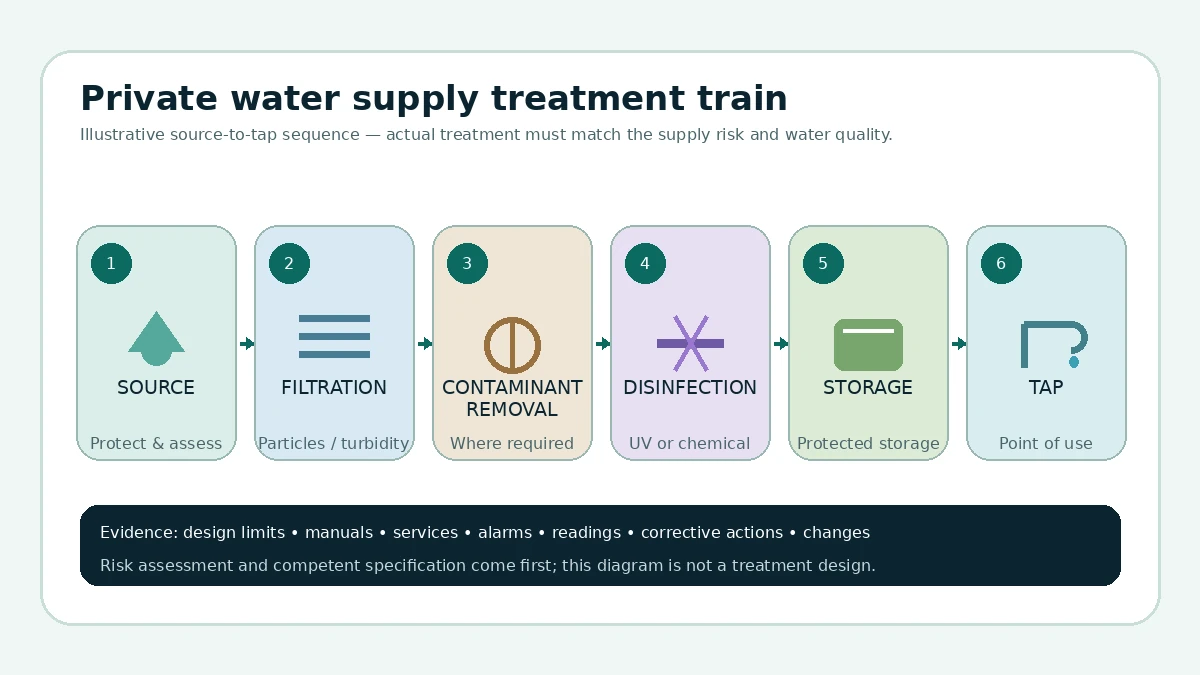
- Choose treatment from the hazards, raw-water quality, flow and demand identified for the actual supply — not from a generic equipment list.
- Use multiple barriers where needed: source protection, filtration or contaminant removal, disinfection, protected storage and hygienic distribution.
- Products, media and treatment chemicals used with drinking water must be suitable for that use and meet the applicable Regulation 5 requirements.
- UV performance depends on water quality, UV transmittance, flow, lamp output, sleeve condition and maintenance; a glowing lamp is not proof of adequate dose.
- Every critical treatment stage needs operating limits, maintenance evidence, alarm/failure response and a route to competent review when conditions change.
Start with the raw water, not the catalogue
DWI advises choosing treatment according to the properties of the water and the contaminants present. Two boreholes can require completely different treatment, and the same source can change seasonally or after land-use change.
Before buying equipment, understand the source, laboratory data, flow requirement, peak demand and distribution system. Ask the installer to explain which hazard each stage controls and what evidence will show that it is working.
The multi-barrier principle
DWI’s Regulation 6 guidance uses a whole-system, risk-assessment-and-mitigation approach. Source protection, collection design, filtration or contaminant removal, disinfection, protected storage and hygienic distribution can each act as barriers. The right combination depends on the hazards present; more equipment is not automatically safer.
Operational records should mirror that source-to-tap sequence. If a final UV alarm activates, for example, the evidence trail should also show upstream filter condition, recent source or water-quality observations, flow conditions and the last maintenance event rather than treating the UV unit as an isolated box.
Products, treatment chemicals and Regulation 5
Regulation 5 controls products and substances used in private water supplies where they may come into contact with water intended for human consumption. DWI explains that this includes treatment chemicals, filter media and components such as pipes, tanks, pumps, valves and point-of-use devices installed or used after 1 January 2021.
Do not assume that a generic filter housing, resin, disinfectant or dosing chemical is suitable for drinking-water use. Keep the supplier specification and evidence of suitability for the intended application, and follow the manufacturer’s operating, storage and dosing instructions.
Pre-filtration
Filtration can remove suspended material, reduce turbidity and protect downstream processes. DWI notes that UV performance can be impaired by turbidity, colour and deposits on the sleeve, so pre-treatment may be necessary before UV. The filter type and duty should be chosen for the actual raw water rather than by micron rating alone.
Record filter type, micron rating or media specification, change criteria, pressure readings where used, backwash settings and replacement dates. Replacing cartridges on a calendar without looking at actual condition or manufacturer guidance may be inappropriate for a variable source.
UV disinfection
UV is widely used for disinfection on private supplies. DWI says effective disinfection depends on adequate UV intensity and residence time, and the manufacturer’s maximum design flow must not be exceeded. Water quality matters too: UV transmittance, turbidity, colour and fouling can reduce the dose reaching microorganisms.
UV output falls as lamps age even when they still visibly glow. DWI gives a typical lamp life of about 10–12 months, but the manufacturer’s interval controls the specific unit. Record lamp replacement, quartz-sleeve cleaning, run hours where available, UV-intensity alarms and any automatic shut-off or power-failure events.
Chlorination
Chlorination can be appropriate where a disinfectant residual is useful through storage or a longer distribution network. DWI explains that effectiveness depends on the chlorine form, dose, water quality, pH and contact time; the contact system also needs to avoid short-circuiting.
Chemical dosing should not be improvised. Keep the approved product/specification information, dosing set-points, calibration and service evidence, residual-monitoring records and a clear procedure for low or high readings, dosing failure and chemical replenishment. Chlorine is not a universal solution for every organism or every raw-water problem.
Iron, manganese, nitrate and other chemical issues
Iron and manganese can occur naturally in groundwater and may also arise from materials or treatment. DWI describes oxidation followed by filtration as a common removal principle. Nitrate can require specialist processes such as ion exchange or membrane treatment, depending on the water and the site.
There is no universal “borehole filter”. Treatment must be matched to laboratory evidence, source behaviour and the risks identified for the supply. Specialist chemical treatment can introduce its own operating controls, waste streams, regeneration chemicals or monitoring needs.
Storage and distribution after treatment
Treatment can be undermined by poorly protected storage, contamination after the disinfection point or stagnant sections of pipework. UV provides no residual disinfectant, so post-treatment hygiene deserves particular attention.
Map the direction of flow and record where treated water is stored before use. A treatment service certificate tells only part of the story if downstream tanks or pipes are not maintained.
Point-of-use treatment: useful, but limited
A point-of-use device treats water at or close to one outlet, often a dedicated drinking-water tap. DWI notes that this can be an appropriate mitigation in some circumstances, but it may be unsuitable where untreated water could still create a health risk through bathing, washing or other uses.
If point-of-use treatment is part of the control strategy, record exactly which outlets are treated, what the device controls, how users are told which tap to use, its maintenance and consumables, and how failure is detected. Do not present a treated kitchen tap as proof that the whole distribution system is safe.
Maintenance records that prove what happened
- Asset name, manufacturer, model and serial number.
- Installation and commissioning information.
- Manufacturer operating and maintenance instructions.
- Filter/media/lamp/chemical replacement history.
- Alarm and fault events.
- Contractor service certificates.
- Operator checks and readings.
- Corrective actions after failure or poor water-quality results.
This evidence is valuable during a risk assessment, investigation or contractor handover. It also reduces dependence on one person remembering how the plant was operated.
Practical checklist
- Identify the hazard each treatment stage is intended to control.
- Keep manufacturer instructions for every asset.
- Record filters, media and lamps against the correct equipment.
- Log alarms and power failures, not only planned services.
- Protect treated-water storage and distribution.
- Reassess treatment if raw-water quality, demand or source conditions change.
How to specify treatment without buying the wrong equipment
A treatment supplier should understand raw-water analysis, source variability, peak and average flow, storage, intended consumers and the downstream distribution network. Ask which contaminants or hazards each proposed stage addresses, what design assumptions were used and what monitoring or maintenance proves that the stage remains effective.
Keep the commissioning information. Years later, a new contractor should be able to see the intended flow, filter configuration, media, UV model, dosing set-up and alarm philosophy without starting from scratch.
Common treatment-train examples
Sediment filtration followed by UV
This is common on small supplies where the raw water is otherwise suitable for UV. The filter protects the UV process by reducing particles and fouling. The records should therefore connect filter condition with UV alarms, sleeve cleaning and water-quality observations.
Iron/manganese removal followed by filtration and UV
Groundwater containing dissolved iron or manganese may need oxidation and filtration before final disinfection. Backwash performance and media condition are part of the treatment barrier. A UV lamp replacement schedule alone would not demonstrate that the upstream stages are operating correctly.
Chlorination with contact storage
Larger or longer networks may use chlorine so a disinfectant residual is maintained. Correct dosing, contact time, pH and residual monitoring become core operating controls. The storage and distribution system is part of the disinfection design rather than a passive container.
What to record for every treatment asset
- Manufacturer, model, serial number and installation date.
- The hazard or water-quality issue the asset is intended to control.
- Design flow and key operating limits supplied by the manufacturer or designer.
- Consumables and service intervals.
- Normal readings, alarms and failsafe operation where applicable.
- Every planned service, breakdown, repair and recommissioning.
- Manuals, commissioning sheets, certificates and contractor recommendations.
This creates an asset history rather than a collection of invoices. If performance deteriorates, the history can show whether the problem followed a source change, missed service, changed flow or recurring equipment fault.
Treatment failure and contingency
Critical treatment should have a defined response to power loss, lamp or UV-intensity failure, dosing failure, blocked filters, loss of pressure, abnormal readings or other alarms. The correct health-protection action is supply-specific: isolate unsafe water where appropriate, contact the responsible person or competent adviser, preserve the evidence, and follow any local-authority instructions rather than assuming that restarting the equipment makes the water safe.
Treatment is not “fit and forget”. Routine operator checks, supported by competent servicing and water-quality verification, can identify deterioration before a planned annual visit. A failure should feed back into the risk assessment, maintenance plan and contingency arrangements where it reveals a new or inadequately controlled hazard.
When to reconsider the treatment design
Revisit the design when raw-water quality changes materially, demand increases, buildings are added, the source is altered or repeated failures suggest that the current barriers are not robust. A series of increasingly frequent cartridge changes may be a symptom of changing source conditions rather than a reason to accept ever-shorter maintenance intervals.
Keep design changes and as-built information versioned so the current schematic always matches the plant that is actually treating the water.
Frequently asked questions
Is UV enough for every private water supply?
No. DWI says treatment must be selected for the water quality and hazards. UV may need pre-treatment, has no residual disinfectant in downstream storage or pipework, and cannot remove dissolved chemical contaminants.
How often should a UV lamp be changed?
Follow the manufacturer. DWI notes that typical lamp life is around 10–12 months, but the correct replacement and cleaning interval is unit-specific and lamp output can fall even while the lamp still glows.
Can I choose treatment from one laboratory result?
Usually not safely. Treatment design should consider the source, variability, risk assessment, representative water-quality evidence, peak flow, storage and distribution. A competent supplier or water professional should assess the system.
What does a multi-barrier approach mean?
It means controlling hazards at several points — for example source protection, filtration or contaminant removal, disinfection and protected storage — so safety does not depend on one device.
Do treatment chemicals and filter media need to be suitable for drinking water?
Yes. Regulation 5 controls products and substances that may affect the safety or quality of water intended for human consumption. Keep evidence that chemicals, media and relevant components are suitable for the intended drinking-water application.
Can I treat only the kitchen tap?
Sometimes point-of-use treatment can be appropriate, but it does not automatically make untreated water elsewhere safe. DWI notes that point-of-use treatment may be unsuitable where untreated water poses a risk through bathing, washing or other uses. The decision should be risk-based and site-specific.
Keep the records behind this work together.
Use the free tools or start a 7-day trial to see how sampling, maintenance, actions and documents can sit in one source-to-tap record.
- DWI: Private water supply treatment guide
- DWI: Manual on treatment for small water supply systems
- DWI: Regulation 5 — products, substances and disinfection
- DWI: Regulation 6 — risk assessment and mitigation
- DWI: UV disinfection
- DWI: Chlorine disinfection
- DWI: Comparing and verifying treatment solutions
Regulatory guidance can change. Check the current DWI material and your local authority for the position applying to your supply.