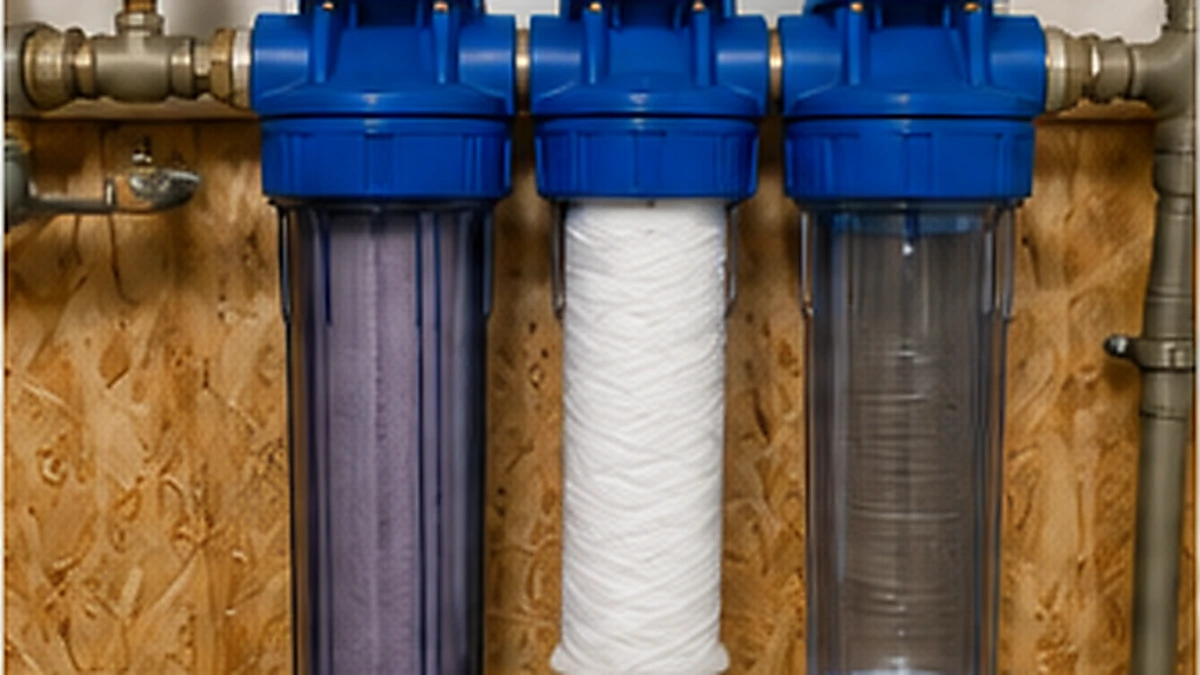
- What role do filters play?
- Filter types are not interchangeable
- How to recognise when service is needed
- Filtration before UV disinfection
- Activated carbon and specialist media
- Hygiene, bypasses and safe maintenance
- What to record for each maintenance event
- Risk assessment and material treatment changes
- Using the Maintenance workspace
- Evidence, investigations and handover
- England and the other UK nations
- Frequently asked questions
1. What role do filters play?
Filtration is one possible part of a private water supply treatment train. DWI's treatment guidance describes physical filtration, adsorption and specialist media as different processes used to remove different contaminants or prepare water for a later treatment stage. The right process depends on the source water and the hazards that need to be controlled.
That means the useful maintenance question is not simply “when did I change the filter?” It is “what control is this filter meant to provide, how do I know it is still working as intended, and what evidence shows that it has been maintained?”
2. Filter types are not interchangeable
| Filter/process | Typical role | Maintenance point |
|---|---|---|
| Sediment / particulate cartridge | Removes suspended particles and can protect downstream equipment. | Track the exact cartridge specification, loading/fouling and replacement basis. |
| Multimedia / sand / pressure filtration | Reduces turbidity or suspended solids; configuration varies. | Record backwash/service activity, media condition and settings where applicable. |
| Activated carbon | Adsorbs selected taste, odour and organic/chemical contaminants. | Media capacity is finite; replacement/regeneration must follow the actual design and service guidance. It is not a disinfectant. |
| Iron / manganese treatment | Often uses oxidation followed by filtration or proprietary media. | Record backwash/service, media work and water-quality evidence relevant to performance. |
| Specialist media | Targets a defined contaminant such as nitrate, arsenic or another chemical depending on the media. | Do not substitute media or intervals casually; keep the supplier/design specification and verification evidence. |
| Pre-filtration before UV | Improves the water presented to the UV reactor by reducing particles or other interfering material as required by the design. | Keep pre-filter condition and UV alarms/monitoring connected so repeated fouling is not treated as an isolated consumable issue. |
A micron rating by itself is not a complete treatment specification. Two cartridges with similar nominal ratings can differ in construction, capacity and intended use. Record the manufacturer/model or other exact specification supplied for the system rather than relying on colour, size or a generic label.
3. How to recognise when service is needed
There is no universal rule such as “change every three months” that is correct for every private water supply. DWI's record-keeping guidance says the treatment documents should state the maintenance requirements and the criteria/regime for replacing products or substances, and that equipment manufacturers' instructions should be followed as a minimum.
Depending on the design, useful operational evidence can include:
- time or throughput: the interval or treated volume specified by the manufacturer/service provider;
- pressure differential: an increase across a filter where the installation is designed to measure it;
- flow change: reduced flow or loss of capacity that is not explained elsewhere;
- visible condition: heavy fouling, sediment or abnormal colour on a cartridge where visual inspection is meaningful;
- water-quality trend: increasing turbidity, colour, iron/manganese or another parameter relevant to the filter's job;
- downstream warning: UV intensity/UV transmission problems, alarms or repeated fouling that point to upstream pre-treatment performance.
Do not invent universal pressure-drop or flow thresholds. Use the limits for the actual housing, media and treatment design. If service intervals suddenly shorten, record that change and investigate whether raw-water conditions, source protection or another upstream problem has changed.
4. Filtration before UV disinfection
Filtration and disinfection are different functions. DWI says UV is most effective when the water is of good quality and particularly low in colour and turbidity. Particles can shield microorganisms from UV light and can increase lamp/sleeve fouling; upstream treatment is therefore commonly used where the raw water requires it.
Do not translate that into a generic promise that “a five-micron filter makes UV safe.” The needed pre-treatment depends on the raw water, the validated UV equipment, required dose, UV transmission/absorbance, flow and the hazards identified. Where Cryptosporidium control is relevant, DWI gives specific pre-filtration/turbidity considerations that should be handled by competent design rather than a generic website rule.
5. Activated carbon and specialist media
Activated carbon is useful for selected taste, odour and organic/chemical issues because it adsorbs contaminants onto the carbon surface. It does not automatically disinfect water. DWI's treatment comparison also warns that bacterial growth can occur on particulate or carbon filters where they are not maintained appropriately.
Specialist treatment media may be designed for iron/manganese, nitrate, arsenic or other defined contaminants. Capacity and maintenance can depend on influent concentration, flow, contact time, regeneration/backwash arrangements and media chemistry. Keep the design/service information with the asset so a later contractor or owner can tell what the media was intended to remove.
6. Hygiene, bypasses and safe maintenance
Changing a cartridge opens the treatment system. Clean hands/tools, protected replacement components and the manufacturer's procedure matter because maintenance can introduce contamination if housings or cartridges are handled badly. Where the installation instructions require cleaning, disinfection, flushing, running to waste or another recommissioning step, record that it was completed. This guide deliberately does not invent a universal sanitising recipe.
Do not casually bypass a filter or other treatment stage just to restore flow. If that stage controls an identified water-safety risk, bypassing it can remove part of the treatment barrier. Use the supply's contingency arrangements and seek appropriate advice where treatment cannot be kept in service.
7. What to record for each maintenance event
A specific document called a “filter maintenance log” is not a statutory form under the England Private Water Supplies Regulations. However, DWI recommends accurate maintenance records and says treatment operating/maintenance instructions and replacement criteria should be retained because they support active management and the local-authority risk assessment.
- Supply and treatment asset affected.
- Filter type, housing, media/cartridge make/model or exact specification where available.
- Installation date and maintenance/replacement date.
- Reason for the work: planned interval, fouling, pressure/flow change, alarm, water-quality finding or repair.
- Condition found and any relevant pressure, flow or visual observations.
- Replacement cartridge/media batch or specification where useful.
- Person/contractor completing the work and any service report reference.
- Cleaning, flushing, disinfection or recommissioning step required by the equipment procedure.
- Faults, bypasses or alarms encountered and how they were resolved.
- Any follow-up sampling or operational verification required for the circumstances.
- Next check/service date and the basis for that interval.
8. Risk assessment and material treatment changes
In England the statutory Regulation 6 risk assessment is carried out by the local authority for supplies within scope. DWI says it should be reviewed whenever the authority considers the current assessment inadequate or circumstances have changed significantly, giving installation of a new treatment process as an example.
A routine like-for-like cartridge change is maintenance, not automatically a material system alteration. Replacing the treatment process, changing media to target a different contaminant, moving treatment, adding a new bypass, materially changing capacity or redesigning the treatment train is different. Record significant changes in the change-management record and discuss risk-assessment implications with the local authority where appropriate.
9. Using the Maintenance workspace
Private Water Supply Manager does not have a separate “filter module”, and this guide does not pretend that it does. The real workspace supports two relevant records:
- Treatment assets: add a pre-filter, activated-carbon unit or other actual treatment asset with make/model, installation date, last/next service and consumable notes.
- Maintenance: add a due-dated task with a task name and the source/interval basis, then mark it complete when the work is done. The task itself stores its due date, basis and completion state; it is not a detailed service report.
When a service or cartridge change is completed, update the treatment asset's last/next service dates and consumable notes where those fields are relevant, and keep any fuller contractor report or original evidence in the appropriate document/evidence record. The workspace stores the information you enter; it does not decide the correct cartridge, interval or whether water is safe. Use the Treatment Maintenance Planner where you want a separate recurring calendar reminder based on an interval you already have from a valid source.
Keep filter work tied to the actual supply
Open the member workspace and record the asset and maintenance task against the correct supply. Use the manufacturer's/service instruction or other genuine maintenance basis rather than an invented default interval.
Open Maintenance workspace Use maintenance planner10. Evidence, investigations and handover
Good filter records become particularly useful after a failed result, treatment alarm or recurring fouling. Link abnormal findings to the corrective-action record rather than silently resetting the maintenance clock. If repeated filter loading reflects a source or treatment change, capture that in the change log and update the source-to-tap picture as needed.
Keep the equipment manual, service reports, relevant photographs and laboratory evidence with the wider evidence pack. DWI's examples of records and schematics emphasise that maintenance diaries, treatment information and supply plans help the local authority understand the system during risk assessment.
For a broader treatment overview, see Private Water Supply Treatment Systems. For UV-specific records, see UV Treatment on a Private Water Supply: Records to Keep. The general maintenance-log guide covers pumps, tanks and other assets beyond filters.
11. England and the other UK nations
The Regulation 6 wording above is for England. Wales has its own Private Water Supplies Regulations, while Scotland and Northern Ireland operate separate private-supply regimes. DWI's record-keeping and treatment guidance is useful operationally, but do not assume England's regulation numbering or local-authority duties apply unchanged elsewhere in the UK.
12. Frequently asked questions
Does every private water supply need a filter?
No. Treatment should be selected for the hazards and water quality of the individual supply. Some supplies need filtration as part of a multi-barrier treatment train; others may not. The local-authority risk assessment, water analysis, competent design and equipment guidance should inform the treatment required.
How often should a private water filter be changed?
There is no universal replacement interval that applies to every filter. Follow the equipment manufacturer or competent service provider, and take account of the actual source-water loading, pressure or flow behaviour, visible fouling, treatment alarms and water-quality evidence. Record the basis for the interval rather than inventing one.
Is a cartridge filter the same as disinfection?
No. A particulate or cartridge filter mainly removes suspended material according to its design. It does not automatically make microbiologically unsafe water safe. Disinfection is a separate treatment function, for example a correctly designed and maintained UV or chlorination stage.
Why is pre-filtration often used before UV?
UV disinfection works best when the water has suitable clarity and UV transmission. Suspended particles, colour and some dissolved substances can reduce UV performance or increase fouling. The required pre-treatment must be designed for the actual raw water rather than assumed from a generic micron rating.
Should I bypass a filter when it blocks?
Do not casually bypass treatment that forms part of the controls for an identified water-safety risk. A blockage or abnormal pressure loss needs investigation. If water has to be supplied while treatment is unavailable, follow the site-specific contingency arrangements and any advice from the local authority or competent water professional.
What should a filter maintenance record contain?
Useful records normally identify the asset and filter or media, date, person or contractor, reason for work, replacement specification, condition found, relevant pressure or flow observations, faults or alarms, work completed, any significant treatment change and follow-up evidence where needed. Keep the manufacturer or service instructions with the asset record.
Does installing a new filter require a new risk assessment?
A routine like-for-like consumable change does not automatically mean a new statutory assessment. However, DWI says a Regulation 6 risk assessment should be reviewed when it is inadequate or circumstances have changed significantly, with installation of a new treatment process given as an example. Material treatment changes should therefore be recorded and discussed with the local authority where appropriate.
- DWI — Record keeping and maintenance
- DWI — Physical removal of contaminants
- DWI — Comparison of treatment capabilities
- DWI — UV disinfection
- DWI — Regulation 6 risk assessment (England)
- DWI — Examples of records and schematics
- DWI — Private supply legislation (England and Wales)
- Scottish Government — Private water supplies
- DAERA — Private water supplies in Northern Ireland
This is operational guidance, not a treatment design, water-safety assessment or universal service schedule. Use the actual equipment instructions, competent treatment advice and local-authority requirements for the supply concerned.