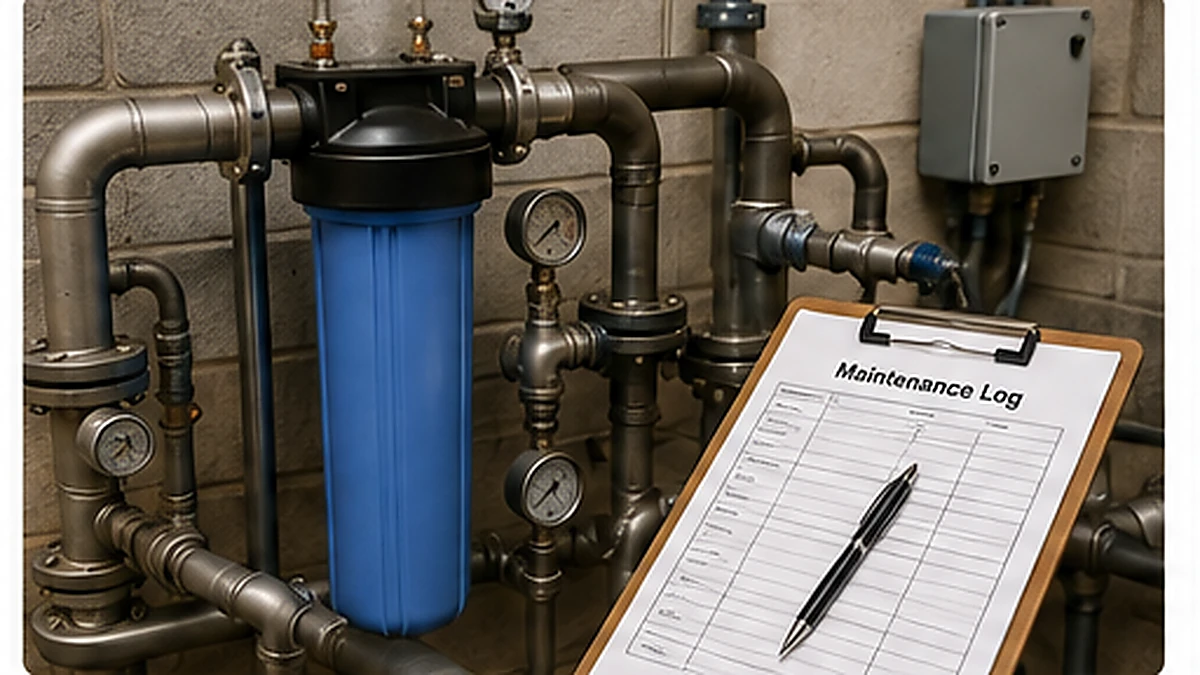
1. What a maintenance log is for
A useful maintenance log answers four simple questions: what asset was involved, what was done, why it was done and what happens next. On a private water supply that can mean anything from checking a spring chamber or pump to servicing filtration, cleaning an approved component, inspecting a tank or recording a contractor visit.
The value is not the word “log”. It is the evidence trail. DWI says management and maintenance records, supply plans and schematics are important information for the risk-assessment process. A clear history also helps a new owner, operator or contractor understand what has been maintained rather than relying on memory.
2. Statutory duties, guidance and service requirements
In England the local authority carries out the Regulation 6 risk assessment, normally at least every five years, except for the limited single-dwelling circumstances in the Regulations. The authority decides what regulatory action is required.
DWI recommends proactive preventive maintenance, routine checks and accurate management records. It says manufacturers’ maintenance instructions should be followed as a minimum operational requirement.
Treatment equipment should come with operating and maintenance information. Use the actual manufacturer, installer or competent service guidance for that equipment rather than a generic internet timetable.
Your own log can connect asset details, work done, evidence, due dates and follow-up. It is useful evidence, but the software does not certify that maintenance was sufficient or that the water is safe.
3. What to record for each maintenance job
Keep enough detail that another competent person could understand the event months later. A practical record will often include:
- Supply and asset: the supply, location and component affected.
- Date: when the inspection, service, repair or replacement happened.
- Work: what was checked, cleaned, adjusted, replaced, repaired or tested.
- Reason: scheduled maintenance, manufacturer interval, risk control, abnormal condition, contractor recommendation or another genuine basis.
- Condition found: leakage, wear, fouling, damaged covers, abnormal noise, alarm state, corrosion or other relevant observation.
- Parts or consumables: enough specification to identify what was installed where that matters.
- Person or contractor: who did the work and, where relevant, the competent service company.
- Evidence: service sheet, invoice, photograph, test or commissioning information where useful.
- Next step: next due date or a recommendation that needs its own corrective action or change record.
Do not turn the log into a dumping ground for personal information. Record the operational evidence you actually need and keep original contractor documents in the appropriate document/evidence record.
4. Assets and components to cover
A whole-supply maintenance record is broader than filter changes. The assets you need to track depend on the actual source-to-tap system.
Spring chambers, borehole headworks, well covers, catchment protection, drainage and access protection.
Source pumps, booster pumps, pressure vessels, relevant switches and associated controls.
Filtration, UV, dosing, aeration, iron/manganese stages, specialist media and any other process actually installed.
Tanks, lids, vents, overflows, screens, level controls, inspection access and relevant hygienic condition.
Pipework, valves, isolation points, leaks, repairs, long branches, washouts and other known network assets.
Alarms, monitoring devices, power supplies, backup arrangements and other equipment that supports continued safe operation.
Keep asset names consistent with the source-to-tap schematic. If “Booster pump 2” appears in the maintenance history, it should be possible to identify the same component in the asset record or schematic.
5. How to set maintenance intervals
There is no sensible universal “private water supply maintenance schedule”. Different equipment, sources and operating conditions need different frequencies. Build intervals from evidence, including:
- the equipment manufacturer’s current operating and maintenance instructions;
- competent installer or service-contractor requirements;
- the hazards and controls identified through the supply’s risk assessment;
- water-quality and operational evidence, including abnormal trends or repeated fouling;
- actual loading, usage, seasonality and environmental conditions;
- previous service history and recurring faults; and
- specific local-authority requirements or regulatory actions where applicable.
DWI recommends a preventive rather than reactive programme. It gives examples such as checks on disinfection equipment, investigation of dirty or discoloured water, manufacturer-led filter maintenance, source inspections and structural inspection of treatment plant, storage tanks and pipework. Those examples are not a universal timetable for every supply.
6. Source, headworks and pumps
Maintenance starts before the treatment room. Source protection and structural condition are part of the whole-system risk picture. Record inspections or work on spring chambers, well or borehole headworks, covers, seals, drainage, fencing or other controls that protect the source from contamination.
For pumps, record the actual service or fault information available to you: the component, symptoms, work carried out, parts changed and any follow-up. Do not invent pressure, electrical or servicing limits. Those belong to the equipment documentation and competent technician.
If a repair exposes or alters underground pipework, update the supply plan while the location and condition are known. DWI case studies emphasise the value of recording the position, material and condition of mains and the location of valves or other network assets when maintenance gives you the opportunity.
7. Treatment, filters, UV and dosing
Treatment maintenance must follow the treatment actually installed and the risk it is intended to control. DWI says treatment design depends on the raw-water properties and contaminants; the maintenance record should therefore stay tied to the equipment and its operating instructions.
For filters and media, keep this guide at whole-system level and use the dedicated filter-maintenance guide for filter roles, fouling indicators and replacement evidence. For UV, record the equipment-specific checks, alarms, cleaning and lamp/service work required by the manufacturer; a glowing lamp alone does not prove that adequate disinfection is being achieved. See the UV lamp replacement guide for the specific record.
Where chemical dosing is used, competent operation is important. Record service and maintenance against the actual system, but do not use a generic website to invent dosing concentrations, calibration frequencies or commissioning procedures.
8. Storage, distribution and controls
DWI recommends structural inspection of storage tanks and pipework as part of preventive maintenance. A practical log might capture the condition of tank lids, vents, overflows, screens, accessible internal condition, known leaks, valve work and repairs. The separate storage-tank maintenance guide covers tank-specific risks in more detail.
Distribution records become especially useful on older or shared systems. When a pipe is exposed or repaired, note where it is, its material and condition, and update the schematic if the information improves the known network. Keep relevant pressure-control or alarm maintenance with the asset, but use the manufacturer or competent engineer for technical limits and electrical work.
9. Routine maintenance versus other work
Planned inspection, servicing or like-for-like consumable work carried out to an established maintenance basis.
Work responding to a failure, unsafe condition, risk-assessment finding, sample outcome or other problem. Link the maintenance evidence to the corrective-action record.
A new treatment process, source, storage arrangement or material distribution change may affect the risk picture. Record it in change management rather than hiding it as a routine service entry.
Breakdown work during an incident belongs in the incident/emergency chronology as well as the maintenance history. Follow the site-specific emergency plan and authority/professional advice.
10. Maintenance, changes and Regulation 6
Maintenance evidence supports the local authority’s Regulation 6 risk assessment, but keeping a good log does not replace that statutory assessment. DWI says the assessment takes a whole-system approach and should consider management, operation, treatment, storage and distribution.
DWI also says the local authority should review a risk assessment when it considers the current assessment inadequate or when circumstances have changed significantly, with deterioration of raw water quality or installation of a new treatment process given as examples. A routine like-for-like service does not automatically mean a new statutory assessment; a material change should be documented and raised with the authority where appropriate.
If maintenance exposes a recurring defect, repeated source contamination, frequent alarms or another issue suggesting the existing control is not reliable, do not simply reset the due date. Record the problem and connect it to investigation or corrective action.
11. Using the Maintenance workspace and planner
The member workspace has a general Maintenance section rather than a dedicated module for every asset type. A maintenance task stores the supply, task name, due date and the source/interval basis; tasks can be marked complete and remain visible in the maintenance history. Treatment assets are recorded separately with fields for type, name, model/serial details, installation and service dates and notes.
That separation is deliberate: the task tells you what needs doing and when; the treatment-asset record identifies the equipment. There is currently no direct database field linking one maintenance task to a particular asset record, so name the asset clearly in the task rather than implying a relationship the software does not store.
Create tasks from manufacturer instructions, risk controls, professional advice or your own documented operating plan. The public maintenance planner takes an interval you already know and calculates due dates; it does not decide the correct interval for you.
Open member workspace Open maintenance plannerThe planner can also download an .ics calendar series with advance reminders. The alerts are then provided by the calendar application into which you import the file; the website is not a background reminder service.
12. Evidence, handover and investigations
Maintenance records are strongest when they connect to the rest of the supply history. Keep relevant original service sheets, contractor reports and photographs with the evidence pack. Use the schematic to keep asset identity and locations understandable.
After a failed sample, alarm or breakdown, maintenance evidence can help establish what had been serviced, what condition was found and whether a recurring problem exists. It should support — not substitute for — the local authority’s investigation and any competent technical work.
Good records are also useful at handover. The next operator should be able to see what equipment exists, the instructions that apply, recent work, open recommendations and the real basis for future due dates.
13. England and the other UK nations
The Regulation 6 references on this page relate to England. Wales has separate Private Water Supplies Regulations, while Scotland and Northern Ireland operate separate private-supply regimes. DWI’s practical maintenance guidance is useful operationally, but do not assume England’s regulation numbers or local-authority duties apply unchanged elsewhere in the UK.
14. Frequently asked questions
Is a private water supply maintenance log legally required?
There is no general requirement in the England Private Water Supplies Regulations for an owner or relevant person to keep a document specifically called a maintenance log. DWI does, however, recommend accurate management and maintenance records because they support proactive operation and the local authority risk-assessment process.
How often should private water supply maintenance be done?
There is no universal interval for the whole supply. Use the actual manufacturer or service instructions, the risks and controls for the supply, operating conditions, water-quality evidence, service history and any applicable local-authority or competent-professional requirements.
What should I put in a maintenance record?
Identify the supply and asset, date, work done, reason or maintenance basis, condition found, parts or consumables where relevant, person or contractor, supporting evidence and the next due action. Record significant recommendations separately if they need tracking.
Should pumps, tanks and pipework be included as well as treatment?
Yes, where they are part of the supply you manage. DWI’s whole-system approach includes source protection, treatment, storage and distribution. The exact components and maintenance required depend on the real supply.
Does completing maintenance prove the water is safe?
No. Maintenance is one control in a whole-system approach. It does not replace statutory risk assessment, regulatory monitoring, investigation of failures or competent water-safety decisions.
Does replacing treatment equipment require a new risk assessment?
Routine like-for-like servicing does not automatically trigger a new statutory assessment. DWI says the local authority should review a Regulation 6 assessment where it is inadequate or circumstances change significantly, and specifically gives installation of a new treatment process as an example. Record material changes and discuss them with the authority where appropriate.
Does the member workspace send maintenance reminders?
The Maintenance workspace records tasks and due dates. The separate Treatment Maintenance Planner can create a recurring .ics calendar file from an interval you enter. After import, your calendar application provides the alerts; the website itself does not send background reminder notifications.
- DWI — Record keeping and maintenance
- DWI — Treatment guide: maintenance and record keeping
- DWI — Regulation 6 risk assessment (England)
- DWI — Examples of records and schematics
- DWI — Guide for private supply owners/users
- DWI — Private water supply legislation
This guide is an operational record-keeping aid. It is not a treatment design, statutory risk assessment, manufacturer service manual or declaration that a supply is safe.