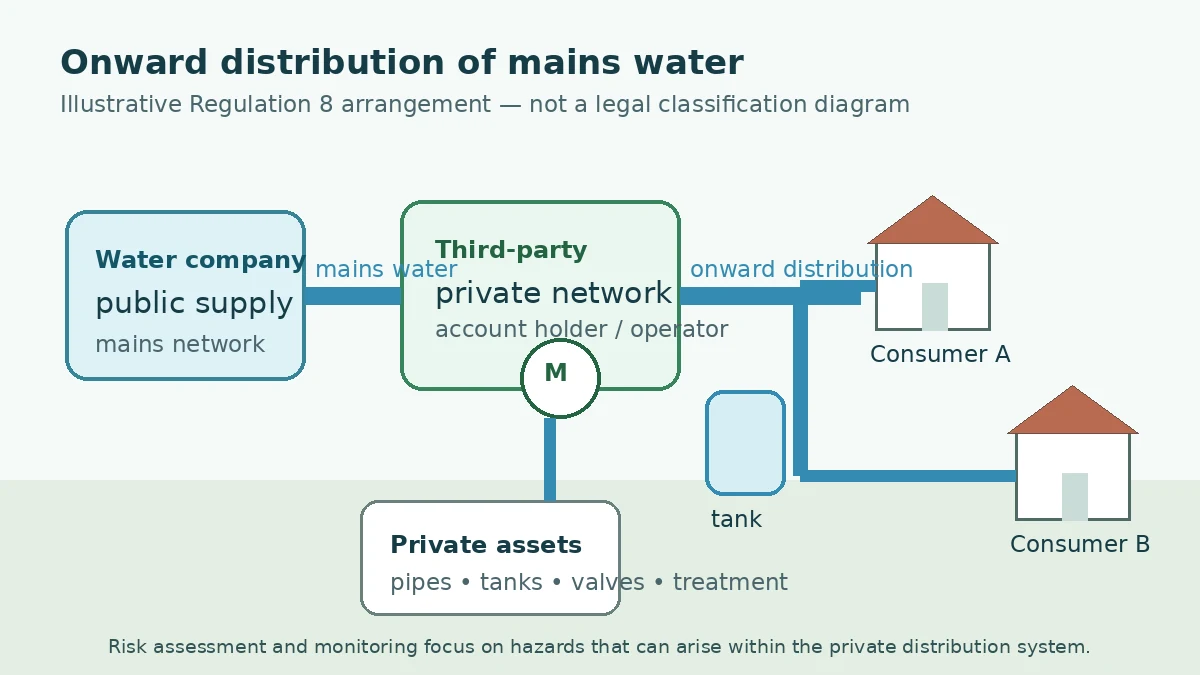
- Regulation 8 is about further distribution of water from a water company through a third party's private system.
- The consumers receive the water indirectly and are not themselves the relevant water-company customers for that onward-distributed supply.
- The local authority risk assesses and monitors the Regulation 8 supply; the monitoring programme is driven by the hazards found.
- A shared or common mains pipe is not automatically Regulation 8. The physical and billing arrangement matters.
- DWI's revised guidance highlights a separate legal issue: creating or extending onward-distribution arrangements can be unauthorised even though existing Regulation 8 supplies still have to be regulated.
1. What Regulation 8 means
Regulation 8 of the Private Water Supplies (England) Regulations 2016 deals with a particular type of private supply: water that originates from a water undertaker or licensed supplier but is then further distributed by someone else. DWI commonly describes these as onward distribution systems or private distribution systems.
The important point is that the final consumers do not receive that water directly as customers of the water company. Instead, water passes through a third party's private distribution arrangement before reaching them. The third party may be a site owner, management company, landlord or another person or organisation.
This makes Regulation 8 fundamentally different from Regulation 9 and Regulation 10 supplies, which typically start from a genuinely private source such as a borehole, spring or well. Here, the incoming water begins as treated public mains water, but risks can arise in the private network downstream of the water-company supply system.
2. What the arrangement looks like
A typical arrangement has three stages: a water company supplies a customer or primary site; that customer or another third party distributes the water through privately controlled pipework or storage; and one or more end users receive their drinking water through that private network rather than directly from the water company.
DWI lists examples of sites where Regulation 8 arrangements may occur, including caravan parks, mobile-home sites, campsites, airports and shopping centres. That list is not exhaustive. The physical route of the water, ownership/control of the private network and the relationship between the water company and end users matter more than the label on the premises.
3. What is not automatically Regulation 8
Not every group of properties sharing pipework from the public mains is a Regulation 8 supply. DWI's revised questions and answers distinguish a private onward-distribution network from a common supply pipe through which consumers still receive water directly from the water company.
If an owner or occupier receives their water bill directly from the water company, DWI says they are not on a Regulation 8 supply merely because a common supply pipe serves several properties. Conversely, where water is physically further distributed through privately owned or controlled infrastructure to consumers who are not on the water company's billing list, Regulation 8 may apply.
This is why a category helper, property description or assumption about who pays whom cannot replace the local authority's examination of the actual arrangement.
4. Why classification needs local-authority judgement
DWI revised its Regulation 8 guidance after legal review and expressly acknowledges that the brevity of the regulation leaves scope for different interpretations. DWI will not determine individual cases on behalf of local authorities. Instead, authorities are advised to make their own assessment and obtain risk-based legal advice where needed.
For an operator or relevant person, the practical response is to preserve the evidence that supports the authority's decision: water-company account details, plans, land ownership information, agreements, billing arrangements, dates when the network was created or altered and the local authority's recorded classification.
Do not quietly overwrite an old classification when circumstances change. Keep the previous decision and the evidence behind the change so the supply history remains auditable.
5. The separate legal position of onward distribution
There is an important complication beyond the Private Water Supplies Regulations. DWI's revised guidance explains that the Water Industry Act 1991 generally prohibits unauthorised use of a water company's supply system by another person to supply water onward, subject to specific statutory exceptions.
DWI states that, in practical terms, no new Regulation 8 supply arrangements could normally be created from 31 July 2002 unless an exception applies. Arrangements created after that date can therefore be unauthorised, and older arrangements may also be unauthorised if they lack the required basis. However, DWI is equally clear that where a Regulation 8 supply exists, it still has to be regulated by the local authority while it continues.
The local authority's job under the private-supply regime is not the same as investigating Water Industry Act offences. If the legality of an arrangement or a proposed alteration is in question, obtain advice from the water company and appropriately qualified legal/professional advisers rather than treating this website as authority to create or extend a network.
6. Risk assessment and five-year review
Regulation 8 supplies require a regulatory risk assessment by the local authority. The assessment should consider the private distribution system from the point where it becomes the onward-distribution arrangement through to the points where consumers use the water.
DWI's Regulation 8 guidance says the test parameters and sampling frequency should be reviewed and amended as necessary every five years as part of the risk-assessment review. Significant changes should not simply wait for the next diary date: altered storage, pipe replacement, new branches, treatment changes, contamination events or major changes in use may change the risk profile sooner.
Keep the current risk assessment beside the schematic and action log. Where the assessment identifies improvements, record who is responsible, the target date, evidence of completion and any verification sampling or inspection.
7. Risk-based monitoring
Regulation 8 does not use a fixed Group A/Group B programme simply because the supply is Regulation 8. DWI says the monitoring of each Regulation 8 supply must be based on the outcome of the regulatory risk assessment, with parameters and frequency reflecting the risk rating and hazards identified.
Depending on the network, DWI examples include coliforms and E. coli, colony counts, conductivity, pH, turbidity, iron, zinc, manganese, aluminium, taste and odour, disinfection by-products such as trihalomethanes or bromate, and metals such as lead, nickel and copper from private pipework and fittings.
That does not mean every parameter must be sampled every time. The point is to maintain the local authority's actual monitoring programme and the risk-assessment rationale, rather than copying a generic internet list into a calendar.
8. Risks inside the private network
The incoming water may meet public-supply standards at the point it leaves the water company's system, yet quality can deteriorate before it reaches consumers. Long private pipes, poor materials, dead legs, low turnover, damaged chambers, unprotected tanks and cross-connections can all change the risk.
Corrosion or unsuitable fittings can introduce metals. Stagnation can affect taste, odour and microbiological condition. Poorly protected tanks can admit contamination. If the private network has its own chlorination or other treatment, the treatment itself introduces operating controls and possible by-products that need to be understood.
Sufficiency also matters operationally. A distribution arrangement that cannot maintain adequate flow or pressure during peak demand may require investigation even if a grab sample happens to meet chemical and microbiological standards.
9. Map the network and sampling points
A Regulation 8 schematic should show more than the water-company boundary. Record the incoming connection and meter, who holds the account, privately controlled mains, storage tanks, pumps, pressure equipment, treatment, branches, isolation valves, significant materials and the premises supplied.
Mark regulatory and operational sampling points clearly. Sampling locations should make sense against the risks the authority is trying to assess. For example, a sample immediately after the incoming mains connection may say little about a distant branch, tank or material-specific hazard further through the private network.
Give assets and sample points stable names. If the network is altered, archive the superseded drawing and record the date and reason for the change rather than silently replacing history.
10. Roles, responsibilities and evidence
The local authority carries the statutory Regulation 8 risk-assessment and monitoring duties. The water company remains responsible for its public supply system, while relevant persons associated with the private distribution system may have responsibilities for access, maintenance, costs and remedial work depending on the arrangement.
Because ownership can be complicated, keep evidence of who owns or controls each part of the private network. DWI case studies show that uncertainty over ownership can make investigation and remediation significantly harder.
Useful records include contact details for the water company, site owner, management company, landlords or freeholders, contractors and affected consumers; access permissions; maintenance agreements; invoices; easements or other property documents where relevant; and local-authority correspondence about responsibility.
11. Water resale and billing records
Some Regulation 8 arrangements also involve water resale. DWI notes that when a party buys water from a water company and onwardly distributes it without holding an appointment or licence, charges to consumers may be subject to the Water Resale Order 2006. Ofwat publishes the current consumer guidance on how the maximum resale price works where that regime applies.
Water-resale charging rules and Regulation 8 drinking-water regulation are related but not identical issues. A lawful or capped charging arrangement does not by itself settle whether the physical supply is Regulation 8, and a Regulation 8 classification does not tell you how a particular bill should be calculated.
Keep the water-company bills, meter readings, consumer charging method and correspondence separate from water-quality records but linked to the same supply. If there is a billing dispute, use Ofwat's current water-resale guidance rather than relying on old figures copied into a site record.
12. Changes, remediation and direct connections
Changes to the private network can affect both risk and legal position. Record proposed and completed pipe extensions, new premises, storage changes, pump changes, treatment additions, connection changes and alterations in who receives water.
DWI's wider Regulation 8 material reflects a long-term preference for resolving onward-distribution arrangements where practicable, often through direct water-company connections, because this removes the private-distribution gap between the water company and the end user. Whether that is technically, legally or financially possible is site-specific.
Where remediation is planned, keep the authority and water company correspondence together with surveys, quotations, drawings, permissions, work records, commissioning information and post-work verification. If a Regulation 8 arrangement ends, preserve the close-out evidence rather than deleting it from the supply history.
13. Practical record checklist
- Local authority Regulation 8 classification and supporting correspondence.
- Water-company account and connection details.
- Current source-to-user distribution schematic plus superseded versions.
- Ownership/control information for private pipework, tanks and other assets.
- Regulatory risk assessment and five-year review date.
- Risk-based monitoring programme and original laboratory reports.
- Sampling-point register and reason each point is used.
- Pipe materials, tank inspections, pump and treatment maintenance records.
- Incidents, complaints, low-pressure/sufficiency issues and investigations.
- Corrective actions, responsible persons, target dates and close-out evidence.
- Water resale/billing evidence where relevant.
- Proposed and completed network changes, including water-company approvals or advice.
14. Common mistakes
- Assuming all shared mains water is Regulation 8. A common supply pipe with direct water-company customers is not the same thing as private onward distribution.
- Assuming treated mains water means no risk assessment is needed. Hazards can arise inside the private distribution network.
- Using Group A/Group B by default. Regulation 8 monitoring is driven by the risk assessment.
- Ignoring the legal status of a new extension. DWI's revised guidance highlights separate Water Industry Act restrictions on creating or extending onward distribution.
- Keeping no ownership evidence. Unclear control of private assets can delay maintenance, investigation and cost recovery.
- Sampling only near the incoming mains. That can miss hazards introduced in tanks, remote branches or private pipe materials.
15. Frequently asked questions
What is a Regulation 8 private water supply?
A Regulation 8 supply is an onward distribution arrangement where one or more consumers receive water indirectly from a water company through a third party rather than directly as water-company customers. The local authority determines whether a particular arrangement falls within Regulation 8.
Is every shared mains-water pipe a Regulation 8 supply?
No. DWI distinguishes a private onward distribution system from a common supply pipe where consumers are still supplied directly by the water company. If a consumer receives a bill directly from the water company, that is a strong indication that they are not receiving a Regulation 8 supply.
Who risk assesses and monitors a Regulation 8 supply?
The local authority has the statutory duty to risk assess and monitor Regulation 8 supplies. Monitoring parameters and frequency are risk-based and should be reviewed as part of the risk-assessment review.
Do Regulation 8 supplies use Group A and Group B monitoring?
No fixed Group A and Group B programme applies simply because a supply is Regulation 8. DWI says monitoring must be based on the regulatory risk assessment and the hazards identified in the private distribution system.
Can a new Regulation 8 supply be created now?
DWI's revised guidance says onward distribution arrangements created after 31 July 2002 are generally unauthorised unless a specific statutory exception applies. Existing Regulation 8 arrangements must nevertheless be regulated while they continue.
What records should an operator keep for a Regulation 8 supply?
Keep the local authority classification, supply and distribution schematic, risk assessment, monitoring programme, laboratory reports, network materials, tanks and treatment details, maintenance, incidents, corrective actions, water-company correspondence and evidence of significant changes together by supply.
Organise Regulation 8 evidence around the actual network.
Private Water Supply Manager can keep schematics, risk assessments, monitoring evidence, maintenance, corrective actions and documents together without pretending to determine legal classification or water safety.
- DWI: Regulation 8 revised guidance
- DWI: Regulation 8 questions and answers
- DWI: Sampling and monitoring for Regulation 8 supplies
- DWI: Types of private supplies in England
- Ofwat: Water resale
This guide applies to England. DWI's Regulation 8 note also discusses Wales, but the regulatory structure and cited Regulation numbers differ. Confirm your own arrangement with the relevant authority.